Friday, June 1, 2018

Detour


Edward G. Ulmer’s 1945 film noir, Detour, is one of the great B-movies of all time. Filmed in black and white on a shoestring budget in a matter of days with no name stars, it is one of the purest distillations of film noir there is. Like all film noirs, it’s the story of a morally ambiguous protagonist who runs into the wrong woman at the wrong time and the universe just seems to be against him. There is no happy ending, just the question of how wrong things can go before either the law catches up with him or the movie ends, whichever comes first. 


Actor and former amateur boxer Tom Neal stars as Al Roberts, a bitter would-be musician, whose lounge singer girlfriend leaves New York for Los Angeles to pursue fame and fortune. The shot of Al walking away from her in the fog once she’s made her decision with only the white globe of the streetlight visible in the gloom is atmospheric and very noir-ish but also an example of how the film’s low budget affected its aesthetic. No need to build a set if all you need is fog and a street lamp.
Once she’s gone, Al turns into even more of a sad-sack, lamenting all the could’ve’s and should’ves. He decides he’s going to do something with his life and join her on the west coast. But because he’s broke, he has to hitchhike. He gets picked up by a shady, misogynist bookie who is also heading to LA, and everything seems great until the bookie is accidentally killed. Al, instead of calling the cops or looking for help, hides the body, takes the bookie’s car, wallet and identity, and takes off for LA.
The story really picks up steam with the appearance of Vera, a hard-bitten hitchhiker who finds her way into Al’s stolen car. Played by Ann Savage, Vera is all sneering venom, greed, and anger. She figures out quickly that Al isn’t who he says he is and from then on it’s a cat-and-mouse game with Vera very much in the cat role. It’s not a nuanced performance but it punches you right in the face, and nuance isn’t always required.


The two become locked in a roundabout of blackmail, suspicion, betrayal, and self-hatred as they hurtle towards Los Angeles. The ongoing banter and battle between Al’s sad sack victim versus Vera’s white hot tough girl is immensely entertaining, and their acidic relationship builds and builds until all that acid boils over.

Detour is famous for its B-picture status, and there are plenty of myths about its production. The director once said that the entire movie was filmed in six days, and the popular legend is that the budget was around 20 grand. However, research reveals the movie was probably made over the course of four weeks, shooting on a budget of about a hundred thousand dollars. That sounds like a lot but by comparison, that same year the Bing Crosby vehicle The Bells of Saint Mary’s was made with a budget of 1.3 million. So the production quality of the Detour looks more like a hundred cents. Cheap rear projection, silly editing mistakes, and sets that look like cardboard at times are all part of the Detour experience.

The film did well enough at the box office at the time and then fell into semi-regular late night rotation on TV. It was in the 70s and 80s that Detour began to be appreciated as a prime example of film noir. Tom Neal and Edward Ulmer both died in the early 70s, but Ann Savage, Vera herself, happily did live appearances in relation to the film well into her 80s.

Detour fell into public domain years ago and is easy to find on Youtube. If you have an hour and seven minutes and feel like a bracing blast of 1940s B-movie darkness and paranoia, Detour is just a click away.

Killer B's


We’ve all heard different actors referred to as A-listers or B-movie actors. Years ago, comedienne Kathy Griffin had a show called Life on the D-List. This terminology comes from the days of double features, back when theaters trying to fill seats would play two movies back to back, sometimes with a newsreel or cartoons in between. The first picture featured recognizable, big-name stars; had high quality, often “important” subject material; had a big production budget; and was often in Technicolor and sometimes a big aspect ratio like Cinemascope. That picture, known as the A picture, had all the good stuff, but because those were expensive to make, market, and show, the second movie needed to be cheap. So, the B picture usually featured actors who were lesser known; a much smaller budget; a less ambitious or perhaps more exploitive story; and was usually in black and white. And so the A-list was born (as was the B list and everything else.)


Double features are a thing of the past, of course, but the idea remains. Prior to the home video revolution of the 80s, made for TV movies were the new second-best in cinema. In the 80s and 90s, the equivalent of the B-picture was a movie going straight-to-video. If it wasn’t good enough to appear in theaters first and was released direct to VHS, it probably starred Lorenzo Lamas and was filmed in the producer’s back yard in Malibu.

The 21st century has brought the advent of streaming video, and initially, a movie going straight to streaming had the same stigma as straight to video. But now Netflix is complicating that by dumping buckets of money on A-listers like Martin Scorcese and others, trying to convince them to release their first-run work either directly to streaming or simultaneously in theaters and online.
A-listers like Will Smith and the horrible Woody Allen have both produced original material for streaming with mixed results at best. Disney is now in the process of establishing its own streaming service. This will have a huge impact on all other platforms considering how many subsidiaries Disney owns and could potentially pull from all other venues. If it proves popular enough, Disney could even choose to release its first run movies on streaming only and cut out the cost of dealing with theater chains altogether. Imagine Frozen 2 or Toy Story 4 or the second half of Avengers: Infinity War only being available for home viewing and then only if you subscribe to Disney’s streaming service.

The idea of what qualifies as A-list or B-list material used to be as easy to identify as figuring out which movie was in color and which was in black and white. But with the advent of more sophisticated moviemaking technology and more prevalent home viewing platforms, those definitions are becoming increasingly complicated.

The financial contraction of Hollywood filmmaking also affects the creation of B-pictures. With budgets for tent pole projects getting bigger and bigger, there’s less money for smaller, less ambitious movies. Because Infinity War cost 316 million dollars to make, there’s less cash to make a small love story or an economical gangster picture. So I worry that B-pictures as we understand them might cease to exist altogether. Instead of small, lesser-known but still interesting pictures coming to the theaters, we may be headed for a future of just getting continually swamped with endless Netflix projects.

And that would be a shame because so much of what we think of when we envision westerns, science fiction movies, gangster pictures, and film noir comes from that low-budget, no-stars tradition. Yes, many of them are low-quality schlock and are just fun to watch because they’re so bad, they’re good. But some are legitimately great movies. Over the next couple of weeks, I’ll tell you about two of my favorite B-movies: 1945’s ultra low-budget noir, Detour and 1954’s wildly influential monster movie, The Creature from the Black Lagoon.

Monday, May 14, 2018

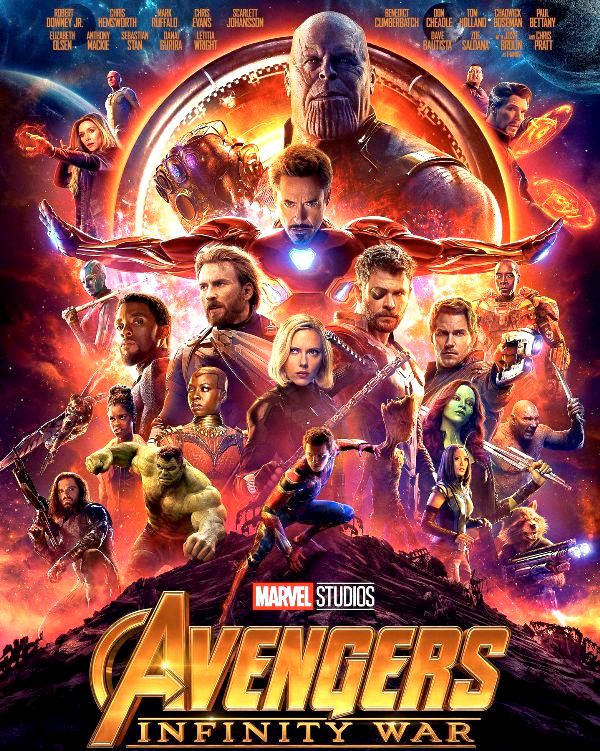
Avengers: Infinity War


Journalist and pop culture writer Reed Tucker wrote a fascinating book called Slugfest: Inside the Epic 50 Year Battle Between Marvel and DC. As the title suggests, it details the ups and downs, blow-outs, brawls, gimmicks, employee stealing, love affairs, and financial fortunes of the two most prominent comic book companies in the world. In this age of superhero ascendancy, when it seems that every tv show, movie, and t-shirt in the world has some kind of costumed do-gooder on it, it’s worthwhile to read a little of the history of the companies that have spawned these characters and universes with such longevity, cultural sway, and financial payoff. Tucker’s argument is essentially that while DC did it first, debuting characters like Batman and Superman in the late 1930s, Marvel has almost always done it better, bringing in younger, hipper, more relatable characters like Spiderman and the X-Men in the 60s. The two companies have a symbiotic relationship, feeding off of one another’s ideas about character, story, format, distribution, and marketing. If Marvel produces a massive, multi-issue crossover event to increase sales, it’s a good bet DC will have one too. If DC creates an edgy, independent line of comics for adults, Marvel will be right behind them. Who does it better is sometimes just a matter of taste, but sometimes there are numbers to back it up. 


After months of hype, anticipation, and drama, DC’s Justice League movie was released last fall to largely unenthusiastic reviews. The mishmash style of the two directors, Zach Snyder and Joss Whedon, the uneven tone, the forgettable CGI villain – it all added up to a whole lot of not much. With a gross of 658 million against a 300 million dollar budget, the film actually lost its studio about 60 million dollars.

On the other hand, Marvel’s answer to Justice League, Avengers: Infinity War, just set a record for earning a billion dollars in eleven days, one day faster than the previous record holder, Star Wars: The Force Awakens. It’s already more financially successful than its sister film at DC, but is it any better of a movie?


 Yes and no. Infinity War is two and a half hours of solid action. Moments of quiet introspection and character development are few and brief. Mostly, it’s just impressive looking production design combined with explosions and fight scenes. So as a stand-alone film, it doesn’t work particularly well. But that’s just it. Marvel’s trick is that it has been building to this moment over the course of ten years and eighteen films. If you have been following the Marvel Universe to this point, Infinity War is funny, exciting, and at moments, touching. If you haven’t been, you are going to be super confused.

Thanos, a giant purple alien built like a brick wall, is determined to collect all of the mystical objects called Infinity Stones and use them to wipe out half of the population in the entire universe. The way he sees it, it will cut down on famine and overpopulation and make sure there are enough resources for everyone. Interestingly, Thanos sees himself as a good guy who is willing to make the hard choices that will spare more suffering later. Naturally, all the Marvel heroes from Spiderman to the Guardians of the Galaxy have a problem with that, especially since one of their own, the Avengers’ The Vision, is powered by one of the stones and Thanos getting it means killing him.

As a movie on its own, Infinity War is probably a confusing mess. As the first half of a capstone for ten years’ worth of universe-building and a reward for faithful superhero nerds everywhere, it’s pretty great. The film proves Reed Tucker’s thesis: on the surface, it appears that Marvel and DC do the same thing, but a closer look reveals that Marvel usually does things better.